Support Our Mission

Your generosity makes a difference! Every gift helps us spread hope, serve our community, and share God’s love with those in need. Thank you for being a part of this mission!

Ways to give:

Securely donate with a card or bank transfer.
Simply drop off your donation during services.

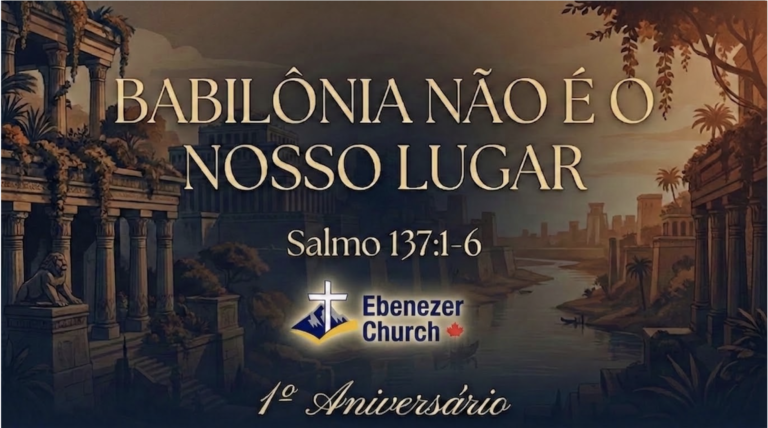
Babylon Is Not Our Home

On Ebenezer Church’s first anniversary, Psalm 137 reminds us that we are a people in exile whose identity and hope are rooted in God, not in this world. The faithfulness that has brought us this far calls us to remember Zion, refuse Babylon, and live by the hope of restoration.


Listen to Audio Version:

¹ By the rivers of Babylon we sat and wept when we remembered Zion. ² There on the poplars we hung our harps, ³ for there our captors asked us for songs, our tormentors demanded songs of joy; they said, “Sing us one of the songs of Zion!” ⁴ How can we sing the songs of the Lord while in a foreign land? ⁵ If I forget you, Jerusalem, may my right hand forget its skill. ⁶ May my tongue cling to the roof of my mouth if I do not remember you, if I do not consider Jerusalem my highest joy! (Psalm 137:1–6)

Introduction

Psalm 137 was written during the Babylonian exile, after the destruction of Jerusalem in 586 B.C., when the people of Israel were taken captive because of their disobedience and idolatry.

Far from their land, from the temple, and from the visible signs of God’s presence, the Israelites wept by the rivers of Babylon, remembering Zion. The psalm expresses pain, longing, and humiliation, but also reveals a profound spiritual awareness: even in a foreign land, the people refused to forget their identity and their covenant with God, keeping alive the hope of restoration.

Today we celebrate one year of Ebenezer Church. And in celebrating this anniversary, our very name preaches to us.

Ebenezer. “Thus far the Lord has helped us.” (1 Samuel 7:12)

Samuel raised a stone so that the people would never forget the faithfulness of God. But in Psalm 137 we find another kind of memorial — not a stone raised in freedom, but tears shed in exile. Not a people in victory, but a people by the rivers of Babylon.

And yet there is something common in both texts: in both, the people survived because they refused to forget.

Samuel said: Remember the Lord’s help (1 Samuel 7:12). The psalmist said: Do not let me forget Jerusalem (Psalm 137:5–6). Because the memory of grace sustains the perseverance of the saints.

Thesis: The faithfulness of God, who has brought us this far, calls us to live with Him even in a foreign land.

How does a church remain faithful in a foreign land?

1. We Must Remember Zion

“We sat down and wept when we remembered Zion…” (Psalm 137:1)

The exile did not destroy the people because the memory of the covenant remained alive. Zion represented the presence of God, worship, promise, and identity.

The weeping of the exiles was not merely grief over the loss of a city. It was grief over the broken communion, the despised covenant, the consequences of their own sin. They wept because they remembered. And that remembrance was, paradoxically, a sign of grace. A spiritually dead people does not long for Zion.

There is a holy lament that God uses to awaken restoration. The suffering of exile produced awareness. Discipline produced memory. And memory rekindled hope.

Ebenezer is also memory. The stone said: Thus far the Lord has helped us. Zion said: We still belong to the Lord. One remembered past faithfulness. The other preserved future hope.

A church remains healthy only when it preserves that spiritual memory — when it does not forget where God has brought it from, when it does not lose the wonder of grace, when it does not trivialize the presence of God.

Thus far the Lord has helped us — but we must always remember Zion.

Psalm 137 teaches us that the spiritual health of a people can be measured by what they mourn and what they refuse to forget. To remember Zion is to remember that we belong to the Lord before we belong to any project, structure, or ministry story.

And in the end, Zion pointed to something greater. Zion pointed to Christ. Because in Jesus, the presence of God came to dwell among us. In Him, the exile of the sinner began to be reversed.

2. We Must Refuse to Belong to Babylon

“How can we sing the songs of the Lord while in a foreign land?” (Psalm 137:4)

This question from the psalmist did not express contempt for worship. It expressed discernment. The oppressors wanted to turn worship into entertainment — songs wrung from a broken people to amuse their very captors. But the people refused. Because there are moments when to resist is also to worship. Faithfulness sometimes shows itself in refusing to sing for Babylon’s pleasure.

And the church today also lives surrounded by cultural Babylons: a culture that relativizes truth, that negotiates holiness, that offers comfort at the cost of faithfulness, that wants an admirable church as long as it is not prophetic.

Babylon wants worship without the covenant — music without holiness, religion without faithfulness, comfort without obedience. But the people resisted.

Babylon is not our home. This statement is a warning to us. Because the danger lies not only in external persecution. It also lies in silent assimilation — when we begin to think like Babylon, to desire like Babylon, to measure success like Babylon, to celebrate like Babylon.

At this point the text confronts us: Are we preserving faithfulness — or negotiating convictions? Are we making disciples — or merely seeking acceptance? Are we singing the songs of Zion — or learning the hymns of Babylon?

We reject its comfort and its idolatry. Our hope is in Zion. Daniel resisted in Babylon (Daniel 1:8; 6:10). Ezekiel prophesied in Babylon (Ezekiel 1:1–3). God preserved a remnant in Babylon. And God still preserves His church amid the pressures of this age — because Christ also overcame Babylon. Jesus remained faithful where Israel failed, resisted where many give in. And by His grace, His church can remain holy in a foreign land.

3. We Must Wait for Restoration

“If I forget you, Jerusalem…” (Psalm 137:5)

This is not merely nostalgia. It is hope. Because God did not end His story with His people in exile. Seventy years later there was a return. But that was pointing to something greater.

The psalmist was not merely gazing at a lost city. He was clinging to the promise that God would still act. Jerusalem, here, was memory — but also prophecy. A remembrance of what had been lost, and an expectation of what God would restore.

This is the difference between biblical lament and despair. Despair closes the future. Biblical lament waits for redemption. Israel wept by the rivers — but God was already writing the return, even when the people could not see it, even when the years of exile seemed too long, even when everything looked like ruin.

Because the hope of God’s people never rests on circumstances. It rests on the promises of the Lord. A church does not live only by memory, nor only by resistance. It lives by hope — hope that God still builds, still purifies, still awakens, still restores.

The restoration of the return from exile pointed to something infinitely greater. Jesus came to bring the true return from exile. In Him we are reconciled. In Him the sinner comes home. In Him guilt is removed. In Him captivity is broken. In Him we are brought back to God. The cross was the great exodus of God’s new people (Luke 9:31). And the resurrection was the guarantee that Babylon will not have the final word.

And we still await the consummation: the New Jerusalem (Revelation 21:1–4) — the city that will not be destroyed, the fellowship that will not be interrupted, the worship that will never again be silenced.

That is why the church walks looking forward — not toward ruins, but toward the eternal city; not toward Babylon, but toward the Jerusalem above. And that hope sustains perseverance, because those who believe in future restoration remain faithful in the present.

Conclusion

Today we raise our memorial stone again. Ebenezer. Thus far the Lord has helped us.

And that help calls us to three commitments:

  • Remember Zion.
  • Refuse Babylon.
  • Live by the hope of restoration.

Babylon is not our home. We confess that we do not belong to this world. And as we call upon the God who restores His people, we renew our trust that the Lord will continue to sustain His church.

And if at times we feel small, let us hear the word of the Lord: “Do not be afraid, you worm Jacob… I myself will help you.” (Isaiah 41:14)

Christ is our Stone of Help. In Him we have come this far. And in Him we will press on.

Pastoral Appeal

After one year of God’s help, is our heart more anchored in Zion — or more comfortable in Babylon?


Ebenezer teaches us to remember God’s help; Zion teaches us never to forget where we truly belong. Small in God’s hands — but never abandoned.