Support Our Mission

Your generosity makes a difference! Every gift helps us spread hope, serve our community, and share God’s love with those in need. Thank you for being a part of this mission!

Ways to give:

Securely donate with a card or bank transfer.
Simply drop off your donation during services.

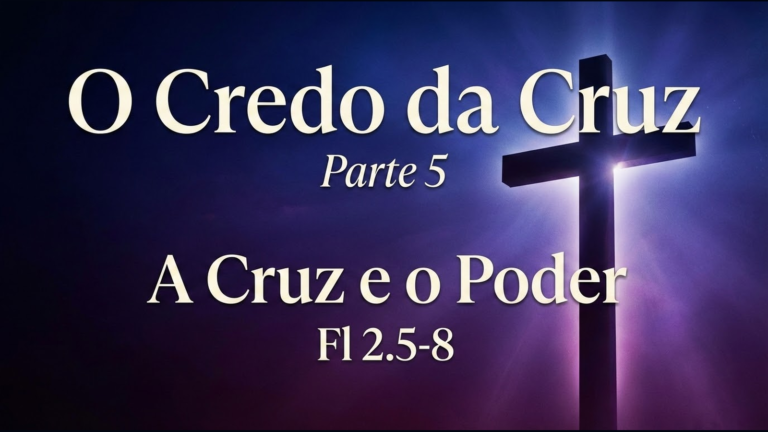
The Cross and the Power — Philippians 2:5–8

In Philippians 2:5–8, Paul presents Christ as the ultimate model of self-emptying and humility. This sermon calls us to embrace the cross not as a symbol, but as a daily program of life — dying to pride, fame, and power so that Christ alone is exalted.


Listen to Audio Version:

“Have the same mindset as Christ Jesus: Who, being in very nature God, did not consider equality with God something to be used to his own advantage; rather, he made himself nothing by taking the very nature of a servant, being made in human likeness. And being found in appearance as a man, he humbled himself by becoming obedient to death — even death on a cross!” (Philippians 2:5–8, NIV)

Introduction

This sermon is part of the series The Creed of the Cross, grounded in the book Cruz Credo by Glenio Fonseca Paranaguá, which confronts the superficiality of modern Christianity and calls us back to the center: the cross of Christ.

The apostle Paul, writing to the Philippians, presented not just a doctrine, but a model for life: Christ Himself. He did not merely speak about humility — He lived it in complete self-emptying. He was obedient unto death, even death on a cross.

We live in a generation that measures success by visibility, influence, and power. But when we look at the cross, we see that God’s way is completely opposite to the pattern of this world. The cross does not exalt man — it empties him. The cross does not promote the ego — it crucifies it.

Theme: In the Cross, our power is to be a vessel for service.

1. It Begins with Self-Emptying

“Rather, he made himself nothing by taking the very nature of a servant.” (Philippians 2:7)

It is necessary to drain the feelings of greatness implanted by sin. There is no salvation without the dislodging of the spirit of self-importance. The problem is not outside us — it is within us.

How many times do we serve expecting recognition? How many times do we obey expecting reward? The cross confronts us because it exposes what we try to hide: our desire to be important, seen, valued, recognized. But while the “self” sits on the throne, Christ will not.

“Covetousness is the disease that is causing the life of our church to dry up in every sense.” — Samuel Chadwick

Many want to grow but do not want to repent. Many want to be used by God but do not want to be dealt with by God. There is no true spiritual growth without real self-emptying. “No man begins to be good until he considers himself bad.” — Thomas Brooks

Application: Today God is not looking for people full of talent, but hearts empty of self. If we want to experience the power of the cross, we must begin where Christ began — in self-emptying.

2. The Cross Is a Program for Life

“Have the same mindset as Christ Jesus.” (Philippians 2:5)

The cross is not an isolated moment — it is a continuous journey that redefines our choices, motivations, and priorities every day. There are enemies to overcome:

Money: “He who serves God for money will serve the devil for better wages.” — Roger L’Estrange. How many decisions have been made not by God’s will, but by financial return?

Fame: We live in a culture of visibility where being seen seems more important than being faithful. “God will not go forward with the man who marches in his own strength.” — C. H. Spurgeon

Power: The desire to be greater than others, always on top, leads to the corruption of life.

The daily cross confronts our practical choices: when no one is watching, when it costs to let go, when it hurts to obey, when it demands dying to self.

Application: There is no discipleship without the cross. The question is not whether we believe in the cross — it is whether we are living by it. The cross must move from our theology into our decisions, from the pulpit into everyday life.

3. Exaltation Comes After Humiliation

“He humbled himself by becoming obedient to death — even death on a cross!” (Philippians 2:8)

Jesus did not seek position — He took the form of a servant. Jesus did not build a reputation — He gave Himself in obedience. He did not promote Himself — He humbled Himself to the cross.

The path of Christ was: Self-emptying → Humiliation → Exaltation. This is not only Jesus’ path — it is the Kingdom pattern for all who follow Him.

The logic of the world says: “Rise, conquer, appear, impose yourself.” The logic of the cross says: “Descend, surrender, serve, die.” We want the exaltation of Christ, but we avoid the path of Christ. First the cross. Then the crown. There is no shortcut.

Application: Perhaps God is using circumstances you don’t understand to produce in you what you still lack. Instead of resisting, the call of the cross is: submit. Because what God does in you is more important than what God does through you. The cross is not loss — it is preparation.

Conclusion

Christ is the center of this message. He emptied Himself. He humbled Himself. He died on the cross. And He was exalted by the Father — our model.

True power is not found in conquering the world, but in surrendering to God. In true Christianity: it begins with self-emptying; the cross becomes a program for life; exaltation comes after humiliation.

Closing question: Are you willing to lose control of your life in order to live the true power of the cross?

The power of the cross is not revealed in who rises, but in who empties himself so that Christ may be exalted.